
Already a member? Click here to Login



Safety Notice: Handmade items made from this pattern may contain small parts or long cords that pose choking or strangulation risks. Not suitable for children under 3 years. Please see the full safety disclaimer at sewmag.co.uk/safety.
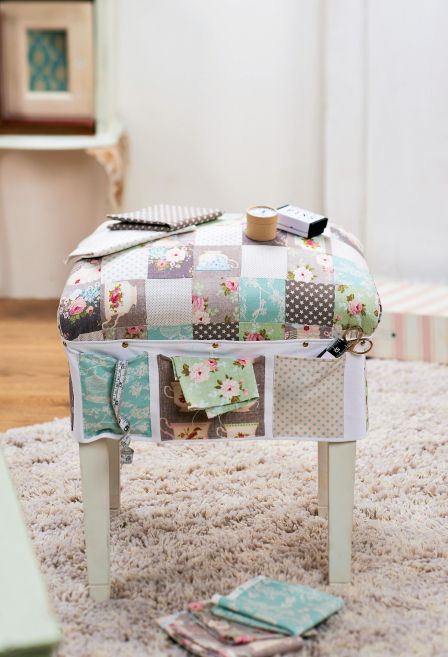
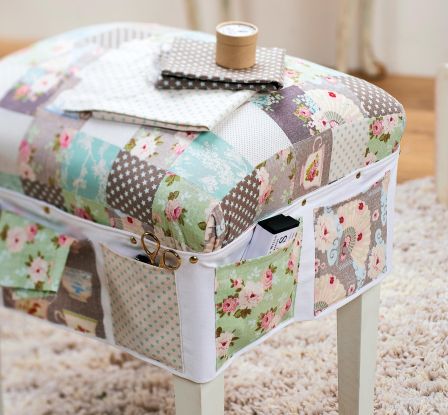
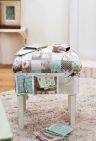
Recovering old furniture is a great way of revamping tired pieces, without spending a fortune. Corinne rescued this dressing table stool from a neighbour’s skip, and with some simple patchwork piecing using pretty Tilda fabrics, she gave it a new lease of life as a useful sewing caddy– ideal for keeping your essential sewing kit, or a cheeky bar of chocolate, to hand.
Stitch a sewing caddy
Prepare a dressing table stool by unscrewing the seat from the base and removing all old fabric and foam if necessary. Clean and paint the woodwork. Replace the foam block and hold it in position with a tight covering of plain cotton. Fix to the underside of the seat with a staple gun.
Measure from the base of the seat, over the dome of the padding and down the other side in both directions. Add 10cm to both dimensions to give you an indication of the size of patchwork panel you will need to make.
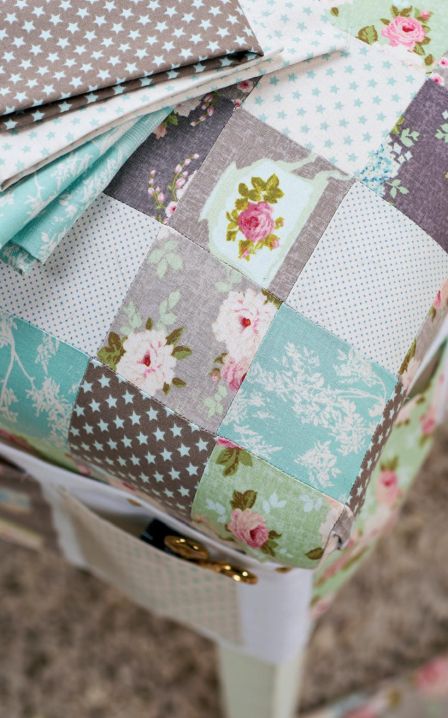
Divide each measurement by six, then multiply the two results to work out the number of patches needed. Cut this number of 7cm squares from patterned fabric. For example, if your measurements are 54cm x 66cm, divide each by six to get nine by 11. Multiplied together, this makes 99 squares.
Arrange the squares into a panel ensuring no two pieces of the same pattern are next to each other. Stitch them together in rows with a 5mm seam allowance, then sew the rows together, matching seams to create a neat patchwork panel. Press on the reverse to flatten all seams.
Place the patchwork panel centrally over the foam pad and pin it in place. Smooth down the fabric in both directions, pinning at the sides and corners. Flip the seat over so the edges of the fabric can be pulled taut and stapled to the underside. Mitre the corners neatly but avoid pulling the material too tight as this could distort the lines of patchwork. Mark the position of the screw holes as you cover them.
Cut a panel of plain cotton slightly larger than the underside of the seat, fold under 1cm on each edge and staple or sew over the raw edges of patchwork to neaten. Find the position of the screw holes and replace the base of the stool.
Measure the distance around the base of the seat and cut a piece of plain cotton 2cm longer x 30cm. Fold it in half lengthways and sew down the long side and one short side. Turn out and press. Fold in 1cm on the raw edge and pin. Top stitch this edge and the other seamed edges.

 Sign in with Facebook
 Sign in with Google