Already a member? Click here to Login
Safety Notice: Handmade items made from this pattern may contain small parts or long cords that pose choking or strangulation risks. Not suitable for children under 3 years. Please see the full safety disclaimer at sewmag.co.uk/safety.
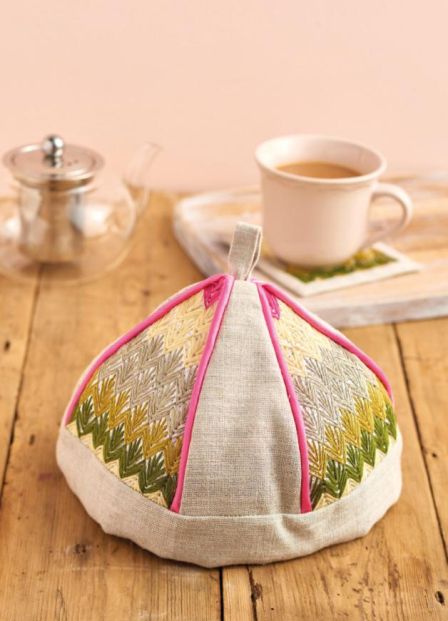
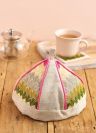
Brush up your embroidery skills with our retro Leaf Stitch Set. Ever since the smash hit Bridgerton graced our screens, searches for embroidery have increased by a whopping 86% online! So, if you’d like to join the crowd and spend time stitching whilst dreaming of Regency balls and garden parties, take up Amanda Walker’s gorgeous tea cosy and coaster set, sewn from neutral fabrics and adorned with dainty leaf stitch embroidery in vibrant colours.
Make a coaster
Download and print the chart from sewmag.co.uk. Cut a 14cm square of embroidery canvas, then thread the needle with six strands of dark green embroidery thread. Count in seven holes from the left-hand side and five holes up from the left-hand base corner; this is the starting point for the first stitch. Pass the needle up from the back of the canvas, leaving a 3cm tail of thread.
Hold onto the tail whilst passing the needle through to the back to form half of the leaf shape. Reverse the sequence to complete the leaf. Repeat four more times. For the next row, thread the needle with light green thread. Repeat the process.
The first leaf will be the right-hand side of the motif. Stitch four whole leaves followed by the left-hand side of a leaf to complete the row, creating a straight edge to the sides of the embroidery. Change to beige thread and sew five whole leaves. The pattern slots into each other as the motif is repeated up the five rows of leaves.
Complete one row of beige leaves, then change to pale yellow thread and stitch a row with half leaves at either end. For the fifth row, sew three whole leaves in yellow, change to pink thread and stitch one leaf. Complete the row with one yellow leaf. Using the remaining chart, at the top and base of the piece fill in the gaps with a seven-point sequence, again reversing the sequence to complete the arrowhead shape. Trim the edges of the canvas to create a 1cm border around all four sides.
Cut a 15cm x 15.5cm rectangle of linen fabric, then fold and press in 1cm on all four edges. Turn the piece over, pinch each corner together and sew a mitre, trimming away the bulk. After completing all four corner mitres, turn the coaster over and press flat, forming a frame in which the embroidery can be positioned. Hand-stitch the edges of the frame to the edges of the embroidery.
Stitch a tea cosy
Embroider three triangular panels. To increase the size, add more leaves to the beginning base row, keeping to an odd number. A 16cm x 18cm piece of canvas is needed for every triangle; this will need to be increased for a larger tea cosy.
Start in the left-hand base corner of the canvas. Use one of the shorter edges as the base of the piece. Sew seven holes in from the side edge and four holes up from the base to create seven dark green leaves across the base. Stitch six light green leaves slotted into the darker green leaves, followed by five beige leaves, then another four beige leaves above.
Change to pale yellow thread and sew a row of three leaves, then two more above and one pink leaf at the top of the triangle. Fill in the base leaves with the seven-point sequence to create a straight line at the base of the triangle. Trim away the excess canvas, leaving a 1cm border around the edge of the embroidery. Make a chart by drawing around the edges of this piece.
Add extra length at the base of the chart, extending the straight side edges of the first row of leaves down by an extra 3cm for the lining. Make a copy of the chart for the linen panels that are sewn in between the embroidered panels, cutting it through the centre from the base to the point at the top of the triangle.
Cross the centre edges over one another at the base until it measures half the width of the original, keeping the point intact. Straighten the base line, then correct the angle of the 3cm extension so that they are at a 90° angle from the base line. This will become the lining chart. Remove the 3cm extension to create the chart for the linen panels. Snip three panels in linen and three panels with the extension in curtain interlining, then another three using the larger chart.

 Sign in with Facebook
 Sign in with Google