Already a member? Click here to Login



Safety Notice: Handmade items made from this pattern may contain small parts or long cords that pose choking or strangulation risks. Not suitable for children under 3 years. Please see the full safety disclaimer at sewmag.co.uk/safety.
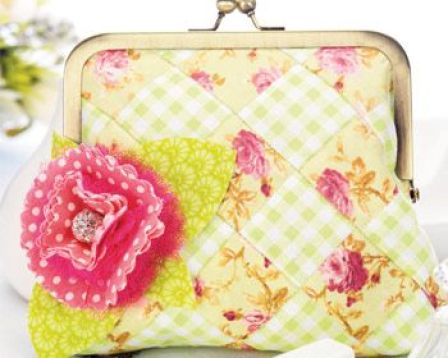
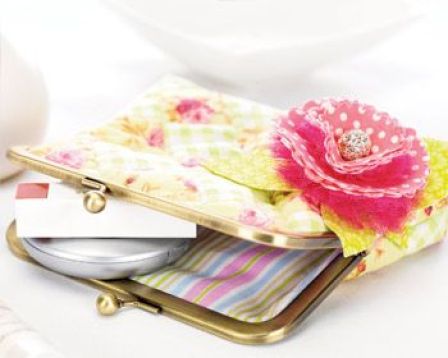
Master the art of inserting a hand stitched bag into a snap-closure frame to create accessories with a professional finish. Make using of a time-saving die-cutting machine to quickly trim fabrics for a patchwork effect and floral corsage accent. Click here to download the template for this project.
Create a Patchwork Panel
Decide which of the three coordinating fabrics will be the lining of your clutch bag and set this aside. Take the two remaining fat eighths and cut both into four long 6cm wide strips. Layer the strips accurately, and place one end directly over the 5cm square on the die. Sandwich the die and fabric between two cutting plates and pass through the diecutting machine. Remove the cut squares, reposition the fabric layers and repeat until the whole length is cut. Provided your placement has been accurate you can cut up to 80 squares from both fabrics in this way.
Sew the squares together to make ten strips of eight squares, alternating the pattern and using a 0.6cm seam allowance. Press the seams open and pin the strips together, dropping down a square each time so the materials form a checkboard pattern and the completed panel can be turned 90 degrees so the squares run diagonally. Stitch the strips together and press. This should result in a parallelogram with a long side of approximately 48cm and a short side of 28cm.
Make a Bag
Locate the bag template on page 79. Lay the patchwork panel flat and lay one pattern piece on the left side, as close to the diagonal as possible while still keeping the base of the bag in line with the bottom edge. Draw around the pattern with tailor’s chalk, remove and flip over so that the other bag piece fits on the remaining piece of patch work. Cut out both pieces on the drawn lines (seam allowance is included on the pattern).
Place the wadding over the lightweight fabric and pin the two patchwork bag pieces on the top. Cut around the bag pieces and quilt through all the layers with a straight stitch. Mark the position of the bag hinges from the pattern (marked with an X) on the bag pieces. Cut two more bag pieces from the fat eighth that was set aside earlier, these will be the lining.
Pin the two quilted pieces right sides together and stitch from one hinge mark, down along the base and back up to the second hinge mark. Make a flat bottom to the bag by pushing one side seam flat against the bottom seam and stitching across the triangle this makes, approximately 3cm from the point. Trim away the point and repeat for the other side. Turn the quilted bag right side out.
Pin and stitch the lining of the bag together as in step 3, ensuring you leave a 10cm gap along the bottom edge for turning later. Flatten corners as you did for the outer bag. Place the quilted bag inside the lining so that the right sides are together and pin the two fabrics together along the top edges. Stitch from hinge mark to hinge mark on both flaps and turn out through the hole left at the bottom of the lining.
Push the lining inside the quilted bag and manipulate all corners and seams before pressing flat if necessary. Remove the lining, fold in the raw edges of the hole and stitch closed. Push the lining back into the bag. Pin around the top flaps of the bag and stitch along this line, 5mm from the seam to keep the edges rigid.
Construct a Clutch
Embellish with a Corsage

 Sign in with Facebook
 Sign in with Google