
Already a member? Click here to Login


Safety Notice: Handmade items made from this pattern may contain small parts or long cords that pose choking or strangulation risks. Not suitable for children under 3 years. Please see the full safety disclaimer at sewmag.co.uk/safety.
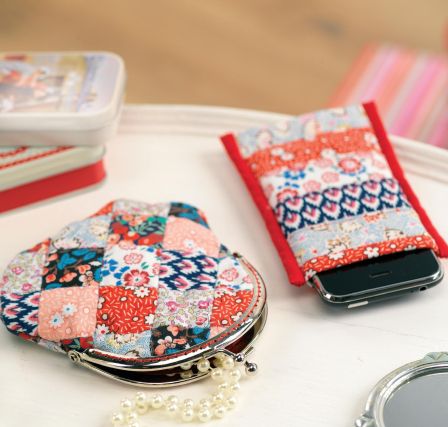
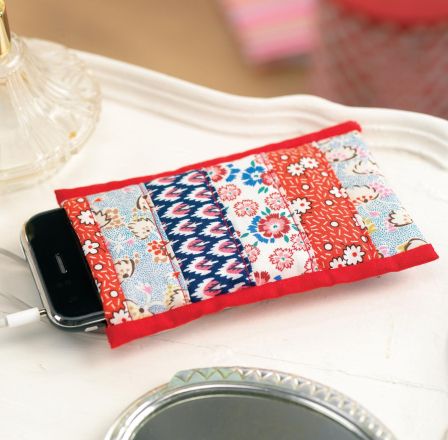
This pretty little pouch can be adapted to fit any phone or mp3 player – simply note down the measurements of your device and create a template to match. The matching coin purse is simple to create and is the perfect introduction to patchwork techniques. Use scraps of colourful fabric to really make it really special.
Make a gadget case
Create a paper template. Measure the gadget that will be going into the case. Add 2.5cm to the width, double the length and add 2cm to it. Cut a paper pattern to those measurements.
From scraps of printed cottons cut 12, 4cm x 12cm cover strips; from plain cotton scraps, cut two 3cm x 15cm binding strips. Press the strips and lay them flat.
Stitch the patchwork cover. Join 10 of the cover strips together along the long edges, working with right sides together and a 6mm seam allowance. Press all of the seams to one side.
Cut a 15cm x 30cm piece of lining and place it face down. Lay a piece of wadding, cut to the same size, on top of it. Place the patchwork cover centrally on top (right side facing upwards) and pin all three layers together. Top stitch each seam. Pin the paper pattern piece centrally over the finished quilting and cut out. Lucinda Ganderton has been designing craft projects for as long as she can remember. She has written a number of needlecraft books, including The Liberty Book of Home Sewing.
Press under a 1cm hem along one long edge of each remaining cover strip. With right sides facing, pin and stitch the raw edges to the short ends of the cover, leaving an 8mm seam allowance. Fold the bindings to the wrong side, tack in place and machine stitch down from the right side.
With wrong sides facing, fold the cover in half and tack the side edges securely together. Press under a 6mm hem along one long edge of each binding strip. Tack the raw edges to the sides of the cover, with right sides facing and the raw edges aligned. Trim the overlap at each corner to 1cm and turn this allowance inwards. Machine stitch through all layers, 6mm from each edge.
Fold the binding to the other side of the case and slip stitch into place. Neaten the folded edges of the binding with a few small stitches.
Stitch a purse
Cut at least 50, 4cm squares from scraps of printed cotton and sew them together, with right sides facing and a 6mm seam allowance, to make a piece of patchwork that is at least 1cm larger all round than the template, which can be found on page 81. Press all seams open.
Cut out the template on page 81 and pin onto the patchwork so that the fold line lies across a seam join between patches, and cut out. Transfer the hinge line markings.
Lay out the patchwork, with right side facing down, and place the wadding on top. Tack the two together, then hand stitch along each patchwork seam line in matching thread to give the work a puffy, quilted appearance. Trim off any surplus fabric.
Fold the work in half with right sides together and pin around the outside edges. Machine stitch the lower side ends from the markings downwards, leaving a 6mm seam allowance. Finger press the top edge of the seams open.

 Sign in with Facebook
 Sign in with Google