Already a member? Click here to Login




Safety Notice: Handmade items made from this pattern may contain small parts or long cords that pose choking or strangulation risks. Not suitable for children under 3 years. Please see the full safety disclaimer at sewmag.co.uk/safety.
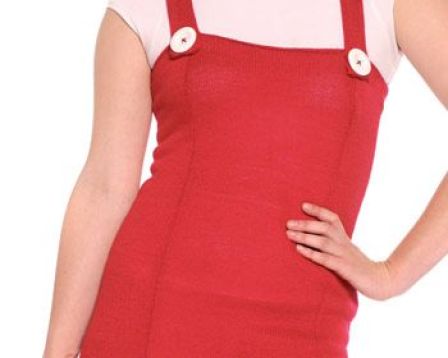
With the new year we often want to reinvent ourselves and our wardrobes, and it's easy to do when you know how! Whether you pick unused items from your closet or visit your local charity shops for inspiration, remember that bigger is better – don’t dismiss items with elasticated waistbands as these are especially useful for adding extra width. When making this cute pinafore start out with a garment with a simple construction – use luxurious fabrics for an evening look or simple cotton for an everyday frock.
Pinafore dress
Assess the garment. Hold the skirt up against yourself, so that the waistband is positioned just above your bust line. Check that its dimensions will allow for the deconstruction and reconstruction to come – if the skirt is too small to fit around your bust it will not easily convert to a dress.
Deconstruct the dress. Once satisfied that the skirt can be turned into a dress, turn it inside out and lay it flat. If it has an elasticated waistband, cut it off – once it’s been removed spread the gathered fabric so that it can be manipulated with more easily.
Create the straps. Measure in and mark a line 3cm from the top and bottom of the skirt with dressmaker’s chalk. Cut away all down the side seam through both thickness’s of fabric. This will go to form your pinafore straps and will become piece (D). You are now left with one long piece of fabric consisting of three pieces: one front, large continuous piece (A) joined to one larger back half (B), joined to one smaller back half (C).
Create the front of the dress. Use piece (B), the larger back piece, to form the front panel of your pinafore. Add a 3cm seam allowance to the bust to bust point measurement (1.5cm to either side) to see how wide the front panel needs to be. Mark this measurement, and your bust-to-waistline measurement, onto the skirt with pins.
Shape the front panel. Using one of the back skirt panels, chalk out the shape of the front centre panel. Taper it in slightly at the tops, the amount will depend on your bust measurement, to allow for the upper bust curvature. Keep holding the panel up to yourself as you go to double check your accuracy.
Assess the shaping. Check that the panel you are cutting is symmetrical by folding it in half. It should be at its widest point around the centre of your chest – it should then taper slightly down to the waist. This is more to give the dress a slight shape rather than to fit your body exactly; the woolly material our sample was made from has enough give in order to make this allowance.
Create the side panels. Cut the side front panels from piece (C), the smaller back panel. Check your bust-to-underarm measurements against the fabric to ensure dimensions are sufficient, then cut two parallel strips to form the side front panels. Although these parts are not shaped at this stage, they will be shaped to fit, if required at the final stage, where you can make that final readjustment by taking in the side seams if there is any loose material there.
Join the front seams. Join the side front panels onto the front centre panel. Starting at the bottom, make sure you line them up as best you can and with the right sides together, sew the side fronts either side of the front panel.
Cut out the back. Place your front dress panels on top of the remaining piece of the skirt fabric, piece (A). Add a 1.5cm seam allowance to either side of your middle-back and middle-waist measurements. Mark these on your fabric using dressmaker’s chalk, then using the front part of your pinafore dress as a guide, chalk your cutting line, hold it up to check it’s correct, then cut it out.
Join front to back. With right sides together and starting at the bottom sew either side of the front and back panels together with a straight machine stitch. Once sewn, try the dress on to make sure it fits; then chalk on the points where you are going to join your straps. Work a line of machine stay stitch all around the top. This will stabilise the fabric, stop it from moving and help prevent it from fraying.
Make the straps. Take piece (D) and lay it out – it is the seam plus 3cm of fabric from where you cut it off the waistband to the hem. One side is already done for you, you just have to stitch down the parallel length. Keeping the right sides together, stitch the other side from top to bottom, making a kind of inside out tube. Turn it the right way. You can use a rouleau loop if you have one, but you can use a knitting needle or even a wooden spoon handle to help you turn it back the right way. Measure where you want your straps to start and end, then add 3cm to this measurement and make a note of it.

 Sign in with Facebook
 Sign in with Google