
Already a member? Click here to Login


Safety Notice: Handmade items made from this pattern may contain small parts or long cords that pose choking or strangulation risks. Not suitable for children under 3 years. Please see the full safety disclaimer at sewmag.co.uk/safety.
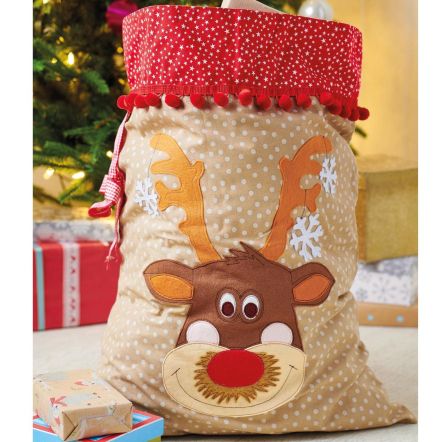
With traditional coloured fabrics and easy-to-sew felt, Carolyn Letten has designed the cutest Christmas swag bag we ever did see – no wonder Rudolph is beaming so! You’ll build up the jolly face on the front, fussy-cutting the moustache after sewing it on, before whizzing up the lining and assembling the sack. A length of velvet pom-pom trim adds the final festive flourish.
Download the templates from sewmag.co.uk and print out. Cut two strips of print fabric, 12cm x 50cm. Pin to each short end of the spot material, right sides together. Join with a 1cm seam allowance, then iron on the reverse.
Snip out all of the main face pieces in felt: use mid-brown for the face, caramel for the antlers and inner ears, white and dark brown for the eyes, pale pink for the cheeks and cream for the main muzzle.
Fold the sack in half, wrong sides together, and mark the bottom fold line, then unfold to pin to the front only. Set the muzzle piece aside and use the photo as a guide to position and pin the other reindeer layers centrally.
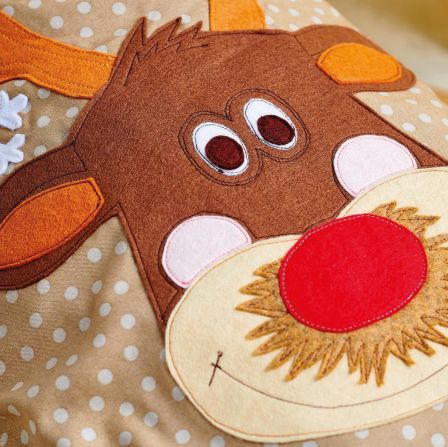
Machine-stitch the pieces in place with matching threads. Pin and sew the eyes layers in place, then outline in dark brown thread. Position the cream muzzle to slightly overlap the face, as shown on the template. Pin and in dark brown thread, stitch around the edge, then add the smile.
For the moustache, snip a piece of light brown melange felt, slightly larger all round, and pin in place. Trace the outline onto tissue, pin it in place, then machine-stitch over the lines using dark brown thread. Tear the tissue away and trim the felt close to the stitches.
Cut out the nose in red felt and attach with contrast thread. Trim one large and two small snowflakes from white glitter felt and attach securely to the front. Sew straight lines in dark thread to ‘hang’ them from the antlers. Iron on the reverse using a mid to low heat.

 Sign in with Facebook
 Sign in with Google