
Already a member? Click here to Login

Safety Notice: Handmade items made from this pattern may contain small parts or long cords that pose choking or strangulation risks. Not suitable for children under 3 years. Please see the full safety disclaimer at sewmag.co.uk/safety.
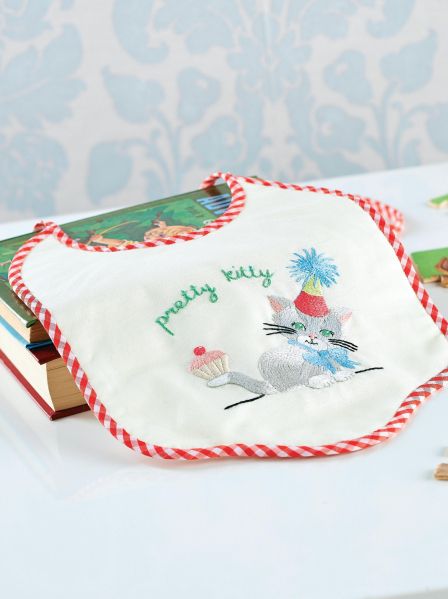
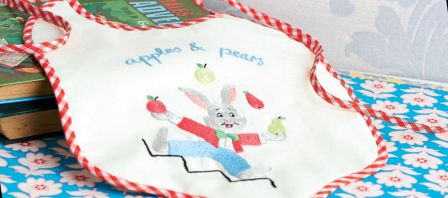
School is in session and this month we're focusing on split stitch, a basic you'll find yourself using over and over again. This traditional stitch was used historically for elaborate embroidered garments such as clerical robes and is one of the main stitches used to make the Bayeux Tapestry. Worked in a similar way to back stitch, it is very easy to do and can be used as both an outlining and a filling stitch. Once confident, you can make these beautiful baby bibs, complete with cute embroidered motifs. Don't save them for best though! Use cotton fabrics and these bibs can be laundered regularly and used every day. Choose between an adorable kitten and a juggling rabbit, or make both!
Make a baby bib
Download the template to find the colours of thread needed. Download the bib template and embroidery motifs, and print. Trace the bib shape onto white cotton fabric but do not cut out. Transfer your chosen embroidery design (see p81) onto the fabric in the centre of the bib shape. Place in an embroidery hoop.
Thread a crewel needle with two strands of embroidery thread and outline the shape you are going to fill with a line of split stitch. It is a good idea to start in the centre of the design and work outwards, so for the kitten you could start with the muzzle, and for the rabbit you could start with the shirt front.
Using the same thread, fill in the shape with split stitch, ensuring the lines of stitches are close together so that the fabric within the shape is completely covered. For some of the smaller shapes, such as the centre of the kitten’s bow, the base of the cupcake and the centres of the eyes, use satin stitch instead of split stitch (see p98).
To emphasise certain areas of the design, such as the outline of the eyes, the whiskers and claws, thread your needle with a single strand of black thread and, still working in split stitch, carefully outline. Other areas can be worked with a single strand of mid-grey or dark grey, such as the soles of the rabbit’s feet and the edges of the head and ears.

 Sign in with Facebook
 Sign in with Google