Already a member? Click here to Login


Safety Notice: Handmade items made from this pattern may contain small parts or long cords that pose choking or strangulation risks. Not suitable for children under 3 years. Please see the full safety disclaimer at sewmag.co.uk/safety.
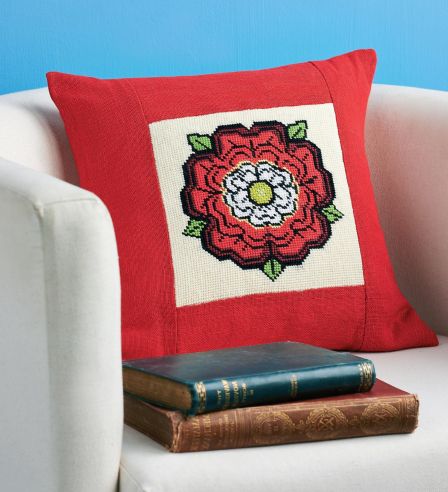
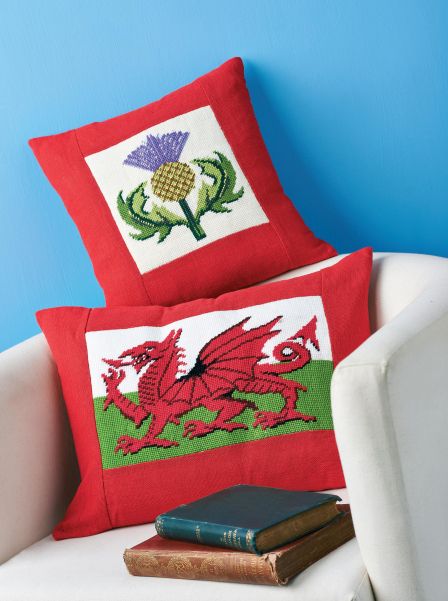
Welcome to our brand-new stitching school! Every month we will be introducing you to a new stitch or technique so you can build on your skills and increase your repertoire. This time we're looking at tent stitch, the basis for most needlepoint designs. It is worked in rows and looks similar to half cross stitch. Once you've mastered it, you can make our lovely trio of cushions, inspired by the emblems of England, Scotland and Wales. The motifs are stitched on tapestry canvas using wool. Even if you’ve never tried your hand at needlepoint before, rest assured that it's quicker and easier than you might think. If you can cross stitch, then you can definitely do needlepoint: the main difference is that every part of the fabric is covered with stitches, essentially creating a new textile.
Make a cushion
Find the colours of wool needed. Then download the tapestry charts and print. Cut the tapestry canvas at least 10cm larger all round than the size of the finished design and place in an embroidery frame.
Measure and mark the centre of the fabric by sewing a line of running stitch along the horizontal and vertical axis, dividing the fabric into four quarters. This will help when following the charted design.
Start working from the centre of the design outwards. Thread a tapestry needle with a strand of wool in the appropriate colour and bring the needle from the back to the front of the work. Leave a short length of yarn at the back and make sure you trap this tail under the first few stitches to secure.
Following the chart and working in tent stitch, make one stitch for every coloured square (or symbol) on the chart, ensuring that all stitches lie in the same direction. Once you have completed the central part of the design, work the background. Add two or three extra rows all round in the background colour.
Remove the finished work from the frame. You will see that it is slightly distorted. To get it back into shape, you will need to block it. To do this, place it right side up on a rigid board, slightly larger than the fabric, and spray all over with clean water. Pin it to the board with drawing pins, placing one in the centre of each side, just outside the line of stitches. As you do this, pull the fabric slightly, to make sure each corner is a right angle. Add more pins, working from the side centres towards the corners.
Once all the edges have been pinned, leave the work to dry completely; this can take a number of days. When your needlepoint is dry, remove the pins and trim the canvas, leaving a 2.5cm margin all round.
For the rose and thistle cushions, cut a 38cm square of backing fabric. Then cut two 10cm x 22cm and two 10cm x 38cm rectangles. Pin and sew the longer rectangles to the sides of your canvas, right up to the stitching, and the shorter ones across the top and bottom. Place right sides together on the backing fabric, trim to exactly the same size, and pin.
 Sign in with Facebook
 Sign in with Google