Already a member? Click here to Login
Safety Notice: Handmade items made from this pattern may contain small parts or long cords that pose choking or strangulation risks. Not suitable for children under 3 years. Please see the full safety disclaimer at sewmag.co.uk/safety.
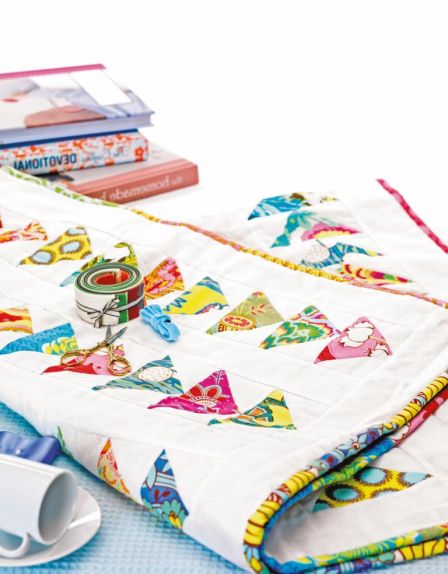
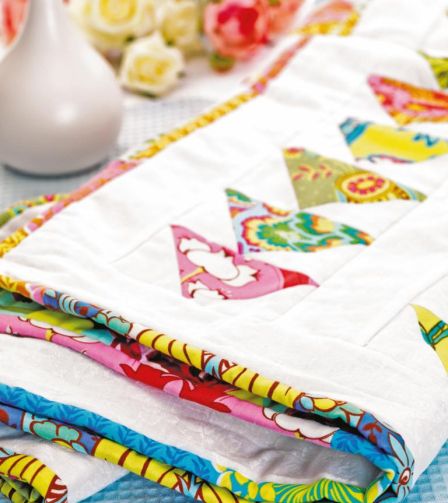
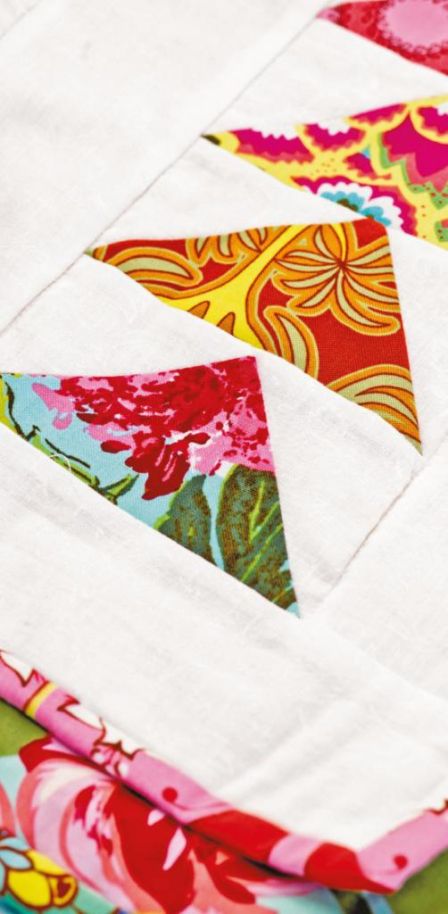
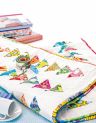
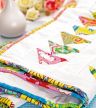
This colourful design uses a clever folded patchwork method that creates bright triangles scattered over a white background, giving the quilt its ‘flying start’ name. Backed in gorgeous Amy Butler cotton and using a jelly roll from the range, this eye-catching quilt will add a splash of beautiful colour to any room.
Make the quilt
Cut the patchwork pieces. Unravel the jelly roll, and lay the strips out onto a cutting mat. Trim them into 11.5cm pieces – create 100 of these in total.
Lay out the plain white cotton fabric and cut it into strips, 6.5cm wide by the entire width of the fabric. Trim each of these strips into 6.5cm pieces, to create squares – make 200 of these in total. Turn the square over, so wrong side is facing up. Using tailor’s chalk, draw a diagonal line through the middle of each square, working from corner to corner.
Assemble the patchwork blocks. Place one jelly roll piece and one white square right sides together, aligning along one of the 6.5cm edges. Pin, then machine stitch along the diagonal line drawn in step 2. Trim away the excess seam allowance, making sure to cut on the correct side of the line (removing the corner, and leaving the larger part of the jelly roll piece intact). Press the seam toward the jelly roll piece.
Lay the stitched patchwork piece right sides upwards, and place another white square onto it (aligning along the opposite 6.5cm edge), again with the diagonal line facing upwards. The diagonal line should run from the centre of the jelly roll piece to the outer corner. Pin, then stitch as before.
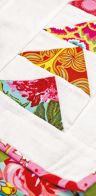
Trim away the excess seam allowance as before, making sure to cut on the correct side of the line once again, removing the corner. Press the seam toward the jelly roll piece. This should create one completed patchwork goose block – a rectangular block made up from one central triangular jelly roll piece, with a white triangle either side. Repeat steps 3 - 4 to make 100 goose blocks.
Piece together the blocks. Place two of the goose blocks right sides together, making sure that the triangle of both faces the same way. Machine stitch along one of the long edges to join. Repeat, stitching the blocks into strips of 20. Press them carefully, to ensure that the seams are not stretched. Trim the long edges to straighten.
Lay out the remaining plain white cotton fabric and cut six strips, each measuring 6.25cm wide by the entire width of the fabric. Set two aside. Place one of the strips right sides together with a patchwork strip, aligning them along one long edge and machine stitching to secure. Repeat, to join each of the strips in turn, alternating between patchwork and plain strips.
Add borders. Press the pieced patchwork to neaten, then place one of the remaining white strips along each of the longer edges, right sides together. Pin, then machine stitch to secure. Repeat along the top and bottom edges, trimming the pieces to fit, and creating a white border around the entire edge of the quilt top.
Sandwich the batting. Layer the quilt, by first laying out the backing fabric, then the batting, and finally the quilt top. Pin together through all three layers. Quilt as desired. Our sample is stitched in the ditch (see Sew Smart) by machine, working along the length of the strips and the top and bottom edges.
Finish with binding

 Sign in with Facebook
 Sign in with Google